Use this play to…
Use this as a strategic “reset” or reflection exercise before a strategic process, to inform the AO/CO strategy and programme priorities going forward. Existing NRC processes tend to be collaborative but also collective, which may not give individual team members the space to consider IP from their perspective. It is also a useful exercise to undertake prior to a shift in programme approach or team structure based on the context or funding situation (as was the case for NRC Iraq in September 2020).
Before you begin…
A Country or Area Office will only get as much out of an IP inquiry as it is willing to invest, so the team will need to commit to the inquiry as Iraq did. This means:
- Driving the TOR design and scope (and importantly, articulating what you will do with this information)
- Providing inputs to the interview guides (can be done through the TOR if the Inquiries direction and scope are already clear)
- Facilitating the logistics for KIIs (and sharing documents)
- Engaging transparently and constructively with the person conducting the inquiry
- Creating opportunities to present and discuss findings (before the report is finalised)
- Following through with commitments in the TOR, and using the findings to inform strategic and programmatic priorities
Who is involved
The value of the IP inquiry comes from the collaboration between the AO/CO and IP Initiative. Therefore, the start the conversation with the IP Initiative!
Materials
key informant interviews (KIIs) with NRC CO staff and global NRC advisors (as relevant).
NRC’s documentation as secondary data sources (global and country-specific)
Running the Play
Step 1: Set the scope (1 week of email exchanges)
Draft v1 of the ToR. The IP Initiative will use this to identify the most appropriate member of the IP team, likely an external consultant with a history of working with the NRC IP team, who will support in finalising v2.
Note on using an external consultant
There are benefits to hiring an external consultant to conduct the inquiry, which is done by the IP Initiative. An external consultant has the time to review documents thoroughly, ensuring connections between previous research/evidence and the review, and can then provide an independent perspective on programmatic issues that may be harder to spot from the inside (confirm what you know, challenge what you think).
Second, doing the inquiry with an external consultant allows key informants within the team to speak openly and confidentially about the challenges they face and solutions they propose, which is more difficult to encourage if someone internal conducts the Inquiry. That said, this could be someone within NRC external to the CO (e.g., from the Regional or Head Office), or even a colleague from another AO (if the Inquiry is at AO level).
If one of the aims of the IP Inquiry is to gain further insights into local perspectives, a local consultant is ideal and can conduct consultations in the local language(s).
Step 2: Iterative document review (2 days work)
The preparatory phase focuses heavily on processing the documents, which should include global guidance, tools and strategies (either specific to certain core competencies or focused on integrated programming), NRC CO documentation, and IP case studies from other contexts. During the interviewing phase new documents will emerge, and key resources should be revisited. .
Step 3: KIIs (10 days work for 20 KII)
The key informant interviews are qualitative, semi-structured discussions centred around an interview guide (for an example, please see Annex 3: Key Informant Interview Guide). Each interview lasts 45-60 minutes and the consultant can take notes after obtaining interviewees’ consent. These notes should not be shared so that feedback remains confidential and cannot be attributed to individuals.
Interviewing external key informants (from other organisations, local authorities, donors, even community members if feasible) offers important perspectives on how NRC can reorient and improve its programming, especially if someone external is doing the IP Inquiry. Even though the inquiry would remain an internal document, external perspectives can sense-check and validate the priorities coming from within the CO team.
Step 4: Preliminary Analysis (2 days)
Tip
Interviewer should remove identifying tags from the document shared with NRC in order to maintain confidentiality.
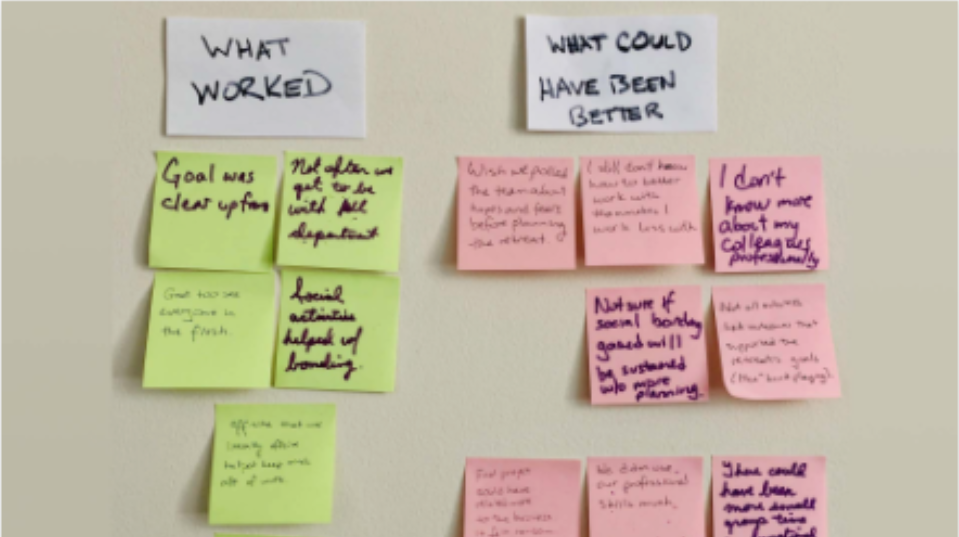
After each interview, key points that highlight common themes or unique perspectives are extracted into a preliminary analysis structure (Annex 5 for an example) based on the inquiry objectives in the TOR and tagged by interview number. Using qualitative analysis and user-centred design approaches, affinity diagramming clusters the findings into key themes and ideas to inform the roadmap and recommendations.
Step 5: Report writing (1 days)
The findings are presented and discussed collectively, ideally written up in a concise report with corresponding roadmap to operationalise the recommendations.
Limitations
This approach to inquiry is based on information obtained through NRC documentation and interviews with NRC Iraq team members. If the findings are not validated by external stakeholders, particularly with communities and aid recipients, they remain uniquely internal perspectives. The results of these consultations should therefore be considered alongside more robust evaluations and reviews that were able to collect primary, quantitative data, particularly with people affected by crisis.