Use this play to…
Set your team up with a consistent and simple explanation of your integration ambition, and the value it delivers to displaced & vulnerable people.\n\nIf you’re struggling with IP Understanding on your IP HealthCheck, running this play might help.
Before you begin…
Just jump right in!
Who is involved
Bring the whole team in for this one!
Materials
Timer
Whiteboard or wall to stick notes on
Markers
Sticky notes
Running the Play
Step 1: Introduce the elevator pitch template (5 min)
For [TARGET GROUP] whose needs are [GOOD / SERVICE] assistance in the form of [INTEGRATION APPROACH] that will ensure [OUTCOME].
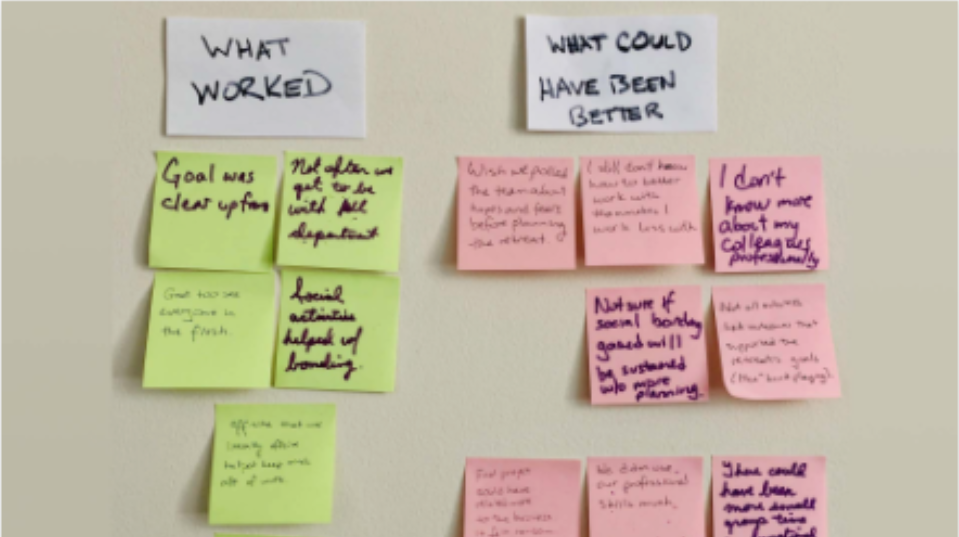
Remind your team that your goal for the session is to come up with a snappy one-liner describing the integration you’re doing/planning and the problem you’re solving. Hand out sticky notes and pens or markers or fire up MIRO.
Step 2: Write lots of elevator pitches (15 min)
Super Tip
People find that doing this play in the morning is more effective.
Working individually (or in pairs, for groups larger than eight), fill in the blanks in the template using a sticky note for each blank. There are no wrong answers here, so just let the ideas flow. Feel free to create a few versions of the pitch if inspiration strikes.
Remember: this is not the same as a vision. It’s narrower than that. The elevator pitch is a way for you to articulate what’s valuable to the people we serve about your integration ambition, in contrast to any non-integrated approaches that might be feasible.
Step 3: Pitch to your team (10 min)
Take turns and have each team member (or group) deliver their pitch.
Be careful not to get caught using team- or humanitarian-specific jargon or (horrors!) acronyms.
Step 4: Discuss and vote (20 min)
Dig deeper to understand each area. Challenge each other and discuss the phrases that resonate the strongest. Then give everyone a marker and ask them to vote by placing a dot on their favorite sticky for each area.
Step 5: Bring it all together (10 min)
Tally up the votes and massage the pitch into a single statement using the top-voted stickies from each area.
If you’re struggling to reach consensus, go deeper. Ask each team member to consider:
- What would happen if our intervention, project didn’t exist? What do we do that others don’t?
- What would we (NRC) lose without this product, project or feature?
- Who would suffer or be affected? Who are our users or target group?