Use this play to…
After a collaborative event like a programme design workshop, it can be helpful for the teams involved to pause and take stock of what happened. Emotions can run high, so it can be difficult for teams to have a discussion that isn’t marred by frustration. The 4Ls Reflection is a useful tool that removes the emotional elements of a collaboration. It empowers staff to highlight the positive elements of the collaboration and understand the negative, allowing them to think from a factual rather than emotional perspective.
The 4Ls Retrospective is specifically focused on action and improvement, and can build trust, improve morale, and increase engagement. It’s designed for any type of collaboration looking to improve by holding a retrospective after a joint event – particularly one that was difficult.
Before you begin…
Traditional in-person teams are used to holding reflections and other collaborative activities in person. As the world and the way we do humanitarian work changes, more and more teams are shifting to remote and distributed models, making collaboration more difficult.
Whether you’re holding your reflection in person or online, the ‘space’ needs to be set up properly. In person, this means ensuring you have writing materials, a whiteboard, or flip charts to visually collaborate and take notes. Online, this can be as simple as copying a version of the Miro template to a fresh board.
Who is involved
Anyone who was involved in the collaboration and could do we time to reflect.
Materials
Zoom with screen share
Whiteboard or large sheet of paper
Sticky notes and markers
Timer
Running the Play
Step 1: Set the tone and expectations (5 mins)
Tip: LARGE GROUPS
Have more than 8 people? Set aside 90 minutes for groups of 8-12, and at least 2 hours for more than 12 people.
Before starting the reflection, make sure all participants understand its purpose. If the collaboration being reflected on was stressful, consider addressing this openly and honestly before starting the reflection.
It is ultimately the facilitators job to set the tone and expectations for the activity, and it shouldn’t be taken lightly. The most successful 4Ls Reflections are completed when all the staff are fully bought into its importance and value, so the facilitator must take extra care to ensure this has happened before starting.
Step 2: Key moments (5 mins)
Tip: LAST T-PERIOD
Looking back at the last T-Period is a good place to start
Agree as a team on the time period you’d like to look back on.
Have the participants think back over the chosen time period. What were the key events that occurred? Provide a few examples, such as goals met, team celebrations, team members joining, partner events.
Anchoring the team in key milestones jogs the team’s memory of events that occurred and how they felt about them.
Then set a timer for 5 minutes for people to add their own key events to the timeline.
Step 3: Reflect (30 mins)
Tip: GIVE IT TIME
Giving time to write allows for processing and reflection while also giving quieter team members space for sharing their ideas.
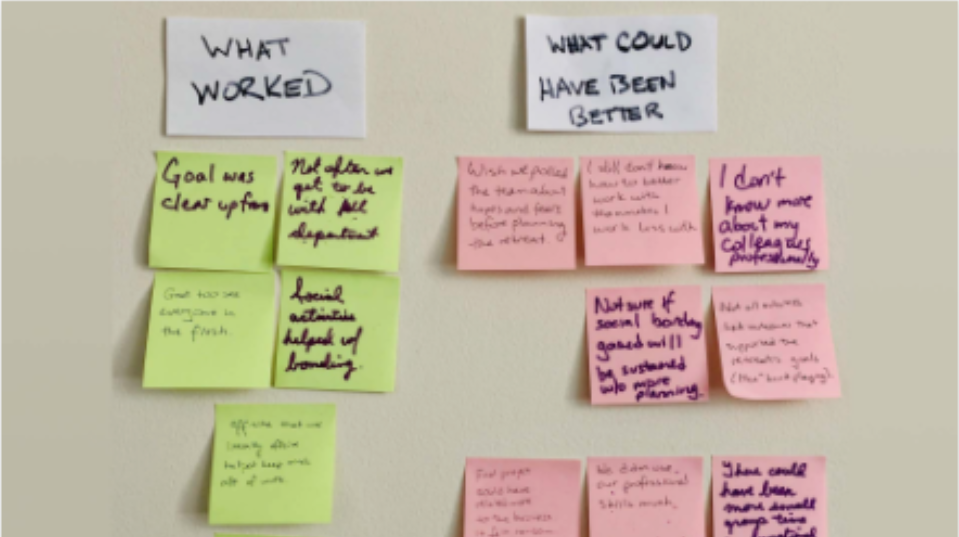
Explain the four lists to the team: ”LIKED," “LONGED FOR,” “LOATHED” and “LEARNED.” Start out individually in silence adding at least one post-it per section. Break out into smaller groups if needed, or keep adding until you run out of steam.
-
LIKED: The first item in the is intended to uncover what people liked about the collaboration/event. This is intentionally broad and open ended. It’s up to the facilitator to guide participants into more and more useful insights into what they liked, and why they liked it.
- The goal is to uncover the underlying reasons for why a particular thing was liked, in order to ensure it happens again during the next collaboration. This is what you want to keep doing, or do more of, in the future.
-
LEARNED: The most valuable lessons are often learned from mistakes made, or challenges overcome during the completion of actual collaboration work. Unfortunately, these lessons often go unshared with other teams trying to work better together.
- This is a wasted opportunity that the 4Ls Reflection is designed to capitalize on. Here we ask participants to reflect on and share anything they might have learned. It’s important for the facilitator to ensure the team understands no learning is too small to share, as well as to guide people into uncovering more learnings than they might have realized.
-
LACKED: This step is designed to surface everything that held the teams back during the collaboration/event. This can be something as simple as slow communication with an external partner, or something more complicated that requires extra analysis to uncover. The purpose of documenting what was lacked during a collaboration is to make sure you don’t run into the same problem in future attempts.
- It’s common for participants to feel uncomfortable sharing what was lacking if they feel leadership doesn’t want to hear about it. This might be because they believe the solution is too expensive or time consuming to be worth investing in. Either way, it’s again up to the facilitator to ensure the team feels comfortable sharing as much as possible during this step
-
LONGED FOR: The last element of the 4Ls Reflection involves reflecting on what was longed for. This can be something tangible like better equipment, or something less tangible, like more or less involvement from leadership.
- Be careful that the ‘Longed for’ section isn’t simply a mirror of the what was lacked section. It will often be similar, but it gives you the opportunity to determine and prioritize what is needed based on the positive impact it may have. For example, if ‘faster computers’ was listed in the ‘Lacked’ section, ‘fast computers’ isn’t necessarily the only thing to add in this step. You might consider including ‘faster internet’ or ‘better software’ as other things that would solve for what was lacked.
Set a timer for 10 minutes for everyone to add their own thoughts to each list.
Step 5: Decide what to do (20 mins)
Give everyone 5 minutes, as a team or in breakout groups, to discuss:
Tip: FOCUS
The fewer actions you have to take, the more likely it is you’ll get them done. Start with just one action item for each list.
- One action you’ll take to amplify from the LIKED list.
- One action you’ll take to remove something from the LACKED list.
- Use your LONGED FOR and LEARNED lists to help shape your ideas for what additional actions to take.
This is perhaps the most important step in the reflection process. If you don’t take the time to assign follow-up action items to specific people or teams, you won’t gain much from having completed the process.
Before ending the reflection, ask for volunteers to own next steps. For any follow-up that doesn’t have a volunteer, assign it to the person most responsible for uncovering the insight during the Play.
Close the session out by confirming everyone understand what is expected of them moving forward, and thank them for their time.
Follow-ups
Need to share your 4Ls Reflection with others? Miro has multiple exporting options, like saving to PDF.